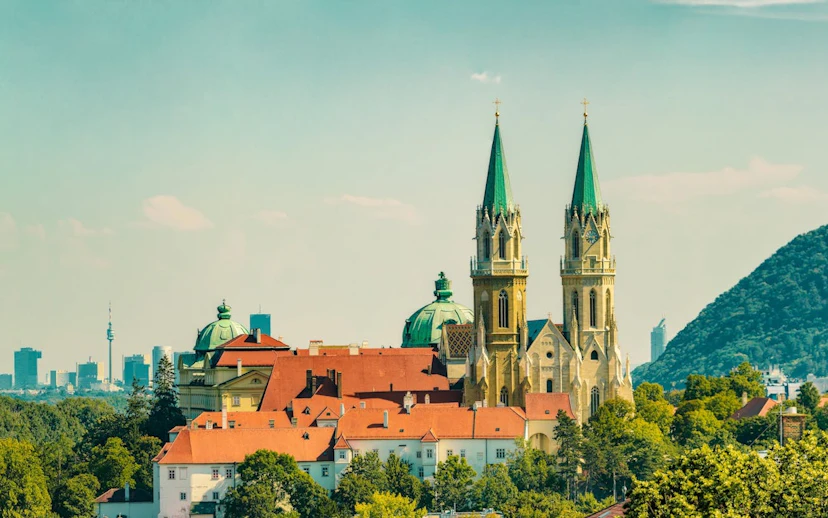
Klosterneuburg Monastery visitor guide from Vienna
Klosterneuburg Monastery is a 900-year-old Augustinian abbey best known for the Verdun Altar, the Archduke’s Crown, and its historic winery. A visit feels bigger than many travelers expect: the site spreads across church spaces, treasury rooms, imperial halls, museums, gardens, and deep wine cellars, so it rewards choosing your route before you arrive. The biggest difference between a rushed visit and a good one is whether you build around the fixed tour times, especially for the cellar. This guide covers timing, tickets, and the smartest way to move through the site.
Quick overview: Klosterneuburg Monastery at a glance
This is the section to read first if you want to plan the visit around your time, not around guesswork.
- When to visit: Weekday mornings and early afternoons are usually easiest; summer weekends and the mid-November Leopoldi festival are much busier because local visitors, day-trippers, and tour groups overlap.
- Getting in: From €15 for all-inclusive entry with access to the treasury, exhibition, museum, scheduled guided tours, and audioguides. You can buy on the day, but booking ahead makes more sense in summer and on weekends if you want a smoother visit built around the tour schedule.
- How long to allow: 1.5–3 hours suits most visitors. It stretches toward the longer end if you add the wine cellar tour, gardens, and the imperial rooms.
- What most people miss: The Imperial Apartments and Marble Hall are easy to skip if you focus only on the church, and the cellar tour adds a completely different side of the monastery that many visitors do not realize is there.
- Is a guide worth it? Yes, if you want the monastery’s art, Habsburg history, and wine story tied together; if you only want the main spaces at your own pace, the included audioguide is enough.
Jump to what you need
🕒 Where and when to go
🎟️ Which ticket is right for you?
🗺️ Getting around
⛪ Significant spaces
♿ Facilities and accessibility
Where and when to go
How do you get to Klosterneuburg Monastery?
The monastery sits above the Danube in Klosterneuburg, about 13km northwest of central Vienna, and it is easiest to reach from Vienna’s Heiligenstadt transport hub.
- Train: Klosterneuburg-Kierling station (S40) → 15-minute walk → The simplest rail option from Vienna if you do not mind a short uphill approach.
- Bus: Stiftsgarten stop (lines 400 or 401) → 10-minute walk → Drops you closer to the abbey grounds than the train.
- Car: On-site parking → short walk to reception → Parking is free for up to 4 hours with validation at the monastery reception.
- Bike: Danube cycle path approach → bike racks near the entrance → Best if you want to combine the visit with a riverside ride from Vienna.
Which entrance should you use?
Most visitors enter through the main visitor reception in the Sala Terrena, and the usual mistake is assuming every highlight can be accessed in any order without checking the guided tour schedule first.
- Main entrance: Located at the main visitor reception in the Sala Terrena. Best for all ticket holders. Expect the easiest entry outside summer weekends and festival days.
When is Klosterneuburg Monastery open?
- Seasonal exhibitions: The annual special exhibition usually runs from May to November.
- Special events: The Leopoldi festival in mid-November changes the feel of the visit significantly because the site becomes much busier than usual.
When is it busiest? Summer weekends, holiday afternoons, and the Leopoldi festival period are the busiest times, with heavier tour overlap and less room to move through the church and treasury comfortably.
When should you actually go? A weekday morning outside the main summer rush is the easiest window because the site feels calmer, tours are easier to build around, and the courtyards and church have more breathing room.
Which Klosterneuburg Monastery ticket is best for you
| Ticket type | What's included | Best for | Price range |
|---|---|---|---|
Entry to Klosterneuburg Monastery | Entry into Klosterneuburg Monastery + admission to the treasury, yearly exhibition and museum + access to all guided tours + audio guides | A first visit where you want the monastery’s main spaces, treasury, and scheduled tours included without deciding on separate add-ons later. | Entry (from €15) ↗ |
How do you get around Klosterneuburg Monastery?
Klosterneuburg is best explored on foot, and while it is manageable in 2–3 hours, the site is large enough that choosing your order matters. The church and reception areas anchor the visit, while the treasury, imperial rooms, museum spaces, gardens, and cellar branch off from there.
Maps and navigation tools
- Abbey church: Baroque interior, organ, and chapels → 20–30 minutes.
- Leopold Chapel: Home of the Verdun Altar and St. Leopold associations → 15–20 minutes.
- Treasury: Archduke’s Crown and ecclesiastical objects → 15–20 minutes.
- Imperial Apartments and Marble Hall: Habsburg-era rooms and views → 20–30 minutes.
- Wine cellars: Historic winery spaces and tasting → 45–60 minutes if you join the guided tour.
Suggested route: Start by checking the next guided tour time at reception, then fit the self-guided church and treasury visit around it; most visitors leave the cellar too late and end up seeing the religious spaces only, which cuts out one of the monastery’s most distinctive experiences.
Maps and navigation tools
- Map: On-site visitor map → covers the main complex and visitor route → pick it up at the Sala Terrena reception before you start.
- Signage: Good enough for the main route, but a map helps once you move between sacred spaces, museum areas, and the imperial section.
- Audio guide / app: Audioguides are included → useful for context in the church, treasury, and museum spaces → worth using if you are not joining every guided tour.
- Large outdoor POIs only: Not applicable.
💡 Pro tip: Check the next cellar or grand tour time before you do anything else — it is easier to fill spare minutes with the church or museum than to rebuild the whole visit once a timed tour is gone.
What are the most significant spaces in Klosterneuburg Monastery?

Verdun Altar
Era: 1181
The Verdun Altar is the monastery’s great masterpiece: 45 enamel panels by Nicholas of Verdun that make it one of the most important medieval artworks in Europe. Even visitors who do not usually linger over church art tend to slow down here because the detail is unusually vivid and narrative-driven. What many people miss is that its power is not just in the goldwork, but in how closely you can read the tiny biblical scenes panel by panel.
Where to find it: Leopold Chapel, within the monastery church complex.
The Treasury and the Archduke’s Crown
Attribute: Habsburg regalia and ecclesiastical treasures
This is where the monastery’s political history becomes tangible. The Archduke’s Crown — often described as the Holy Crown of Austria — is the object most people come away remembering, but the surrounding reliquaries, chalices, and ceremonial pieces matter just as much because they show why the abbey held such symbolic power. Most visitors rush straight to the crown and do not give the smaller treasury objects enough time.
Where to find it: Treasury rooms in the main visitor complex.
Abbey Church
Attribute: Baroque church with earlier Romanesque foundations
The church is the spiritual center of the site and still feels like a living religious space, not a staged historic room. Its marble, gilding, and light make the interior impressive, but the atmosphere changes most during services, when the building stops feeling like an attraction and feels like an active monastery again. Many visitors look up at the ceiling but miss the organ and the quieter side chapels.
Where to find it: Central church at the heart of the monastery complex.
Imperial Apartments and Marble Hall
Attribute: Habsburg state rooms and ceremonial spaces
These rooms show the monastery’s secular side and explain why the site feels so different from a standard abbey visit. The apartments and unfinished Marble Hall reveal Emperor Charles VI’s ambition to turn the complex into something closer to an Austrian Escorial. Many visitors skip this section because they assume the visit is only about church spaces, which is exactly why it deserves more time than it gets.
Where to find it: On the grander imperial side of the monastery, accessed through the guided route.
Baroque wine cellars
Attribute: Historic winery spaces and tasting experience
The cellar tour is where the monastery’s story becomes unusually concrete: this is not a symbolic wine tradition, but Austria’s oldest working wine estate. Walking through the cool brick tunnels and barrel rooms gives the visit a very different mood from the church and treasury above ground. What people often miss is that the cellar is one of the strongest reasons to come here at all, not just a pleasant extra.
Where to find it: Underground cellar system below the monastery, accessed on the guided cellar tour.
Facilities and accessibility
- 🚻 Restrooms: Accessible restrooms are available in the visitor areas, so you do not need to leave the complex to find them.
- 🍽️ Restaurant: Stiftsrestaurant Leopold gives you a proper sit-down meal on-site, which makes it a sensible lunch stop if you are turning the visit into a half day.
- 🛍️ Vinotheque / shop: The on-site wine shop is the most worthwhile place to buy a souvenir, especially if you want to take home the estate’s own bottles.
- 🪑 Seating / rest areas: Benches in the cloister, courtyards, and gardens make it easy to break up the visit if you are moving slowly.
- 🅿️ Parking: On-site parking is available, and visitors can validate up to 4 hours of free parking at reception.
- 🗺️ Visitor reception: The Sala Terrena reception is where you collect maps, orient yourself, and check which guided tour time makes the most sense.
- ♿ Mobility: Main visitor areas are partially accessible with ramps or elevators, but some older sections and stair-heavy historic routes are still difficult.
- ♿ Wheelchair support: Loaner wheelchairs are available, which helps if you want to cover the larger complex without relying only on your own equipment.
- 👁️ Visual impairments: Audioguides are included and help with context, though the visit still depends heavily on visual detail in the church, treasury, and museum displays.
- 🧠 Cognitive and sensory needs: Weekday mornings outside summer are the calmest option, while services, festival periods, and large tour overlaps make the site louder and harder to pace.
- 👨👩👧 Families and strollers: Prams and strollers are accommodated on the main route, but older passages and the cellar section can be less straightforward than the core visitor areas.
Klosterneuburg works best with school-age children who enjoy crowns, big ceremonial rooms, and unusual underground spaces, but younger children usually do better with a shorter route.
- 🕐 Time: 1.5–2 hours is realistic with children if you focus on the church, treasury, and one guided experience rather than trying to do everything.
- 🏠 Facilities: The playground near the entrance and stroller-friendly main route make this easier than many historic abbey visits.
- 💡 Engagement: Ask for the children’s activity sheet at reception if it is available, because it turns the details in the monastery into something more interactive.
- 🎒 Logistics: Bring only what you need, aim for a morning start, and keep the cellar tour only if your children are still engaged after the first hour.
- 📍 After your visit: The monastery gardens and the quieter streets around the complex are the easiest place to decompress before heading back to Vienna.
Rules and restrictions
What you need to know before you go
- Entry requirement: A valid ticket is required, and the simplest option is the Headout entry ticket because it includes the treasury, exhibition, museum, guided tours, and audioguides.
- Tour timing: Several of the most valuable parts of the visit run on fixed guided times, so arriving without checking the schedule can leave you waiting or missing the cellar altogether.
- Church access: During Divine Office, Mass, and other liturgical ceremonies, parts of the church visit can be limited or temporarily unavailable.
Not allowed
- 🚭 Smoking: Smoking and vaping are not permitted inside the monastery buildings or museum spaces.
- 📸 Flash photography: Flash photography and tripods may be restricted inside exhibition halls and sacred areas.
- 🍔 Outside food: Food and drinks are not permitted inside the museum galleries and exhibition areas.
- 🐾 Pets: Pets are not allowed inside the monastery grounds, except for registered guide dogs.
- ✋ Touching exhibits: Do not touch artworks, historical objects, or religious artifacts unless clearly permitted.
- 👗 Inappropriate clothing: Visitors should avoid overly revealing clothing when entering chapel and religious spaces.
Photography
Photography is usually easiest in the open courtyards, larger interiors, and outdoor areas, but the rules can feel stricter in sacred spaces, the treasury, and during active services. Flash is best avoided in the church and around historic objects, and tripods or bulky equipment are not a good assumption for a normal visit. If you want certainty for a particular room or exhibition, check at reception before you start.
Good to know
- Tour language: Many scheduled tours are primarily in German, so non-German speakers should plan to use the included audioguide or confirm language options before arrival.
- Cellar route: The wine cellar is not a space you simply wander into, so treat it as a timed guided experience rather than something you can leave for the end.
Practical tips
- Booking and arrival: You do not usually need to book weeks ahead, but summer weekends and holiday afternoons are worth locking in a few days early if you want the visit to revolve around the cellar or grand tour rather than whatever slot is left when you arrive.
- Pacing: Do the church and treasury while your attention is fresh, then save the imperial rooms or cellar for later; people tend to rush the Verdun Altar early and linger too long in the courtyards when the real time pressure is the guided schedule.
- Crowd management: A weekday morning from Vienna works better here than a late afternoon because you avoid the overlap between local day-trippers, tour groups, and people arriving just for lunch or the cellar.
- What to bring or leave behind: Travel light if you can, because this is a multi-part historic site rather than a single hall, and moving through church spaces, museum areas, and cellar routes is easier with a small bag than a full daypack.
- Food and drink: Eat before you start or plan lunch after the main route; once you are inside the flow of church, treasury, and tour times, stopping midway is what makes the visit feel fragmented.
- Language planning: If you do not speak German, build around the included audioguide from the start instead of waiting to see whether an English-led tour appears, because that uncertainty is one of the few things that can make the day feel less smooth.
What else is worth visiting nearby?
Commonly paired: Vienna Woods
Distance: Information unavailable
Why people combine them: The monastery sits right at the edge of the Vienna Woods, so it is an easy same-day pairing if you want your cultural stop to come with a little more greenery and air.
Commonly paired: Danube riverside route
Distance: Information unavailable
Why people combine them: The Danube setting makes Klosterneuburg work well as part of a relaxed half-day plan with a riverside walk or bike ride instead of a museum-only outing.
Also nearby
Leopoldsberg viewpoint
Distance: Information unavailable
Worth knowing: If you want a panorama to go with the monastery visit, this is the nearby add-on that gives the whole outing a stronger sense of place.
Klosterneuburg town center
Distance: Information unavailable
Worth knowing: The streets around the abbey are quiet, local, and much less touristed than central Vienna, which is exactly why they work well as a slower finish to the day.
Eat, shop and stay near Klosterneuburg Monastery
- On-site: Stiftsrestaurant Leopold serves Austrian food and monastery wine in a proper sit-down setting, and it is worth using if you want lunch without breaking the rhythm of the visit.
- Seasonal wine taverns in Klosterneuburg: Information unavailable.
- Nearby coffee and quick-stop options: Information unavailable.
- Post-visit dining in town: Information unavailable.
- 💡 Pro tip: If you want the cellar tour, eat after the main visit rather than before it, because fixed tour times are harder to recover than a late lunch.
- Monastery vinotheque: This is the best shopping stop here for estate wines and wine-related gifts, and it makes more sense than a generic souvenir if you want something tied directly to the site.
- Museum or general gift shop: Information unavailable.
Klosterneuburg is peaceful, green, and easy to reach from Vienna, but it is not the most practical base if this is your first trip and most of your plans are in the city. It suits travelers who want a quieter stay, have a car, or care more about wine-country calm than late-night city energy.
- Price point: The area usually feels more residential and less tourism-driven than central Vienna, with fewer obvious short-stay options right around the abbey itself.
- Best for: Travelers who want a slower, greener base and do not mind commuting into Vienna for the rest of their sightseeing.
- Consider instead: Stay in Vienna if this monastery is just one stop on a broader city trip, because you will have more hotel choice, more dining nearby, and much easier access to the rest of your itinerary.
Frequently asked questions about visiting Klosterneuburg Monastery
Most visits take 1.5–3 hours. If you add the imperial rooms, museum spaces, and the guided wine cellar tour, you can easily turn it into a half-day trip from Vienna.
No, you usually do not need to book far in advance. Summer weekends and holiday periods are the exception, especially if you want the visit to line up neatly with a specific guided tour time.
Arriving 15–20 minutes early is enough for most visits. That gives you time to collect your map, check the next tour slot, and avoid making the whole day hinge on a missed cellar or grand tour.
Yes, a small day bag is the most practical option. The visit moves between church spaces, museum rooms, courtyards, and cellar areas, so traveling light is noticeably easier than carrying full luggage.
Yes, photography is generally easiest in the courtyards and larger interiors. The more sensitive areas are the treasury, special exhibitions, and any spaces in use for services, so it is worth checking locally if a particular room matters to you.
Yes, the monastery works well for groups. Guided tours are already a core part of the visit, and private tours can make more sense if your group wants a specific language or a stronger focus on art, history, or wine.
Yes, it can work well for families, especially with school-age children. The treasury, church, courtyards, and big underground cellar spaces are visually strong, but very young children usually do better on a shorter 1.5–2 hour route.
It is partially wheelchair accessible, not fully barrier-free throughout. Main visitor areas can be reached with ramps or elevators, accessible restrooms are available, and loaner wheelchairs help, but some older stair-heavy sections are still harder to manage.
Yes, there is on-site dining at Stiftsrestaurant Leopold. If you would rather keep moving, it is usually smarter to finish the church and tours first and then eat, since fixed tour times matter more than meal timing here.
Yes, with the Headout entry product, access to all guided tours is included. The important thing is that the cellar visit still runs to a schedule, so inclusion does not mean you can drop in whenever you want.
Not always. During Divine Office, Mass, and other liturgical ceremonies, visitor access to the church can be restricted or paused, so it is worth being flexible if that is the main part of your plan.
The easiest route is from Vienna Heiligenstadt by S40 train to Klosterneuburg-Kierling, followed by a 15-minute walk. Bus lines 400 and 401 are also useful because they stop a little closer to the monastery grounds.